ARTIST STATEMENT
(b. 1993, Thailand)
Master in Design Studies (MDes), Harvard Graduate School of Design, 2020 Master in Interior Architecture and Design, Penninghen Paris, 2017
Eng.
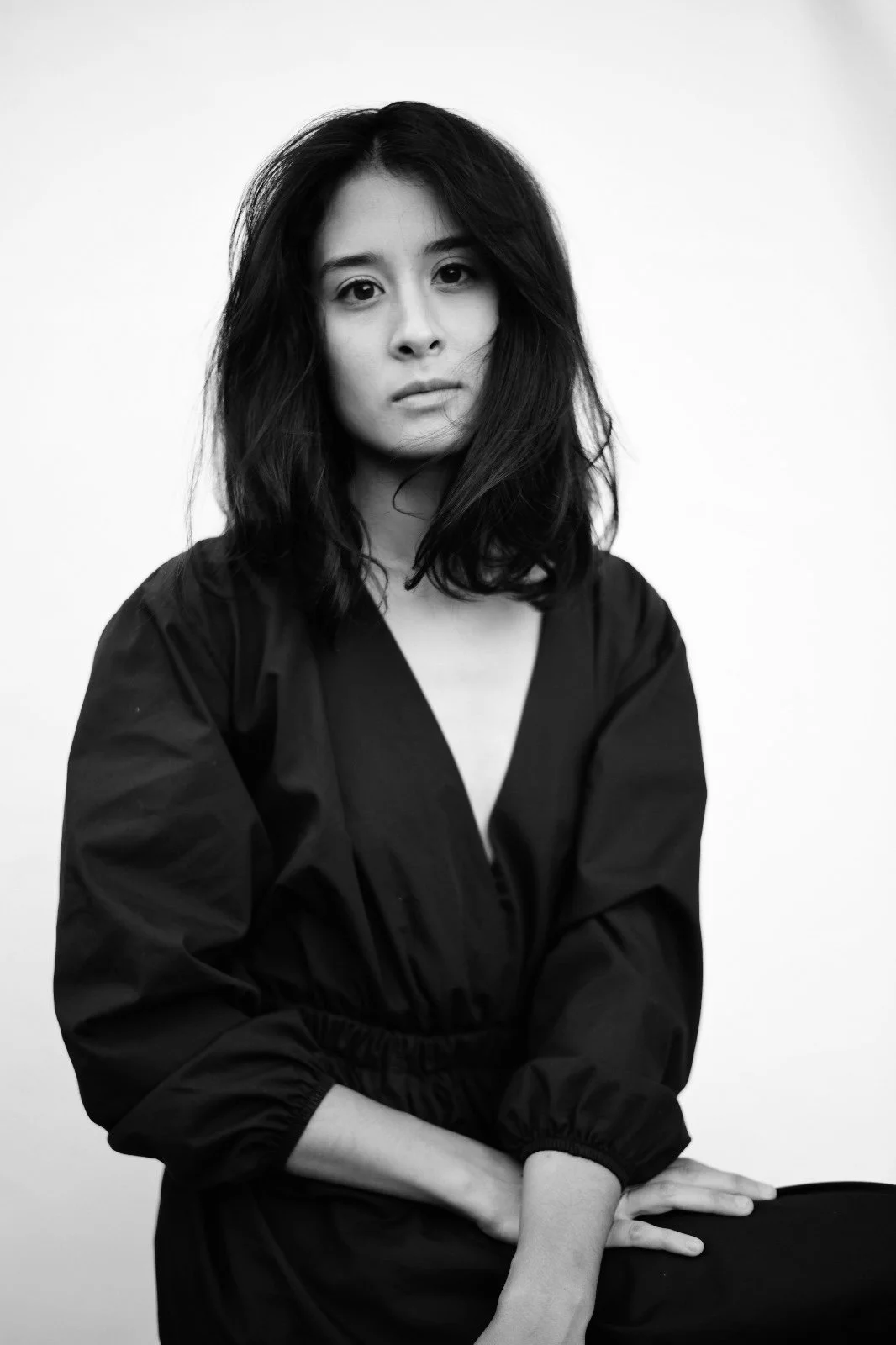
Erano is a French-Thai painter, born in 1993. She lives and works in Paris, France. She holds a Master’s degree in Interior Design from École Penninghen in Paris (2017), and a Master in Design Studies from Harvard University (2020).
Her work centres on the creation of refuge-spaces at the intersection of pastoral tale and dreamlike architecture.
A visual lexicon structures each piece: familiar animals, forest edges, imaginary palaces, celestial vaults, and fragments of classical arches, colonnades, and windows. These architectural devices act as protective boundaries, isolating the scene and turning it into a sanctuary. Yet this world is not impermeable to the tensions of reality. Direct textual inscriptions, collages, scrawled slogans, and ambiguous archetypes haunt the surface, oscillating between irony and confession.
The choice of paper as a support reflects a search for intimacy and vulnerability. By combining the fluidity of oil paint, the raw gesture of charcoal, and the saturation of oil pastels, the surface becomes a tactile dialogue, expressing both graphic and symbolic tension.
Drawing on the narrative power of the fairy tale, the work seeks neither to erase melancholy nor to escape inner exile, but instead makes them the vibrant setting of a re-enchanted world.
Fr.
Erano est une peintre franco-thaïlandaise née en 1993. Elle vit et travaille à Paris. Elle est diplômée d’un Master en design d’intérieur de l’École Penninghen, Paris (2017), et d’un Master in Design Studies de Harvard University (2020).
Son travail s’articule autour de la création d'espaces-refuges à la croisée du conte pastoral et de l’architecture onirique.
Un lexique visuel structure chaque pièce : bêtes familières, lisières de forêts, palais imaginaires, voûtes célestes et fragments d’arches, colonnades ou fenêtres classiques. Ces dispositifs architecturaux agissent comme des frontières protectrices, isolant la scène pour en faire un sanctuaire. Pourtant, cet univers n'est pas imperméable aux tensions du réel. Des inscriptions textuelles directes, collages, slogans griffonnés, archétypes ambigus viennent hanter la surface, oscillant entre dérision et confession.
Le choix du support papier répond à une recherche de proximité et de vulnérabilité. En combinant la fluidité de l'huile, le geste brute du fusain et la saturation des pastels gras, la surface devient un dialogue tactile, traduisant une tension graphique autant que symbolique.
En convoquant la force narrative du conte, l’œuvre ne cherche ni à effacer la mélancolie ni à fuir l’exil intérieur mais en fait le décor vibrant d’un monde réenchanté.